I turned a platform rebuild in chaos into the operating system a whole design department runs on
Goal: turn a design function running on heroics into a department that delivers predictable quality and can scale
Task: I came into platform redesign chaos and built the rituals and methods design runs on, moving on-time delivery from 55% to 79%. This system became the operating model a department (3 divisions) still uses today.
Two levels:
-
The high-level rituals for a department
-
The rituals/methods used in the Feature Development Lifecycle.
1. High-level Department Rituals
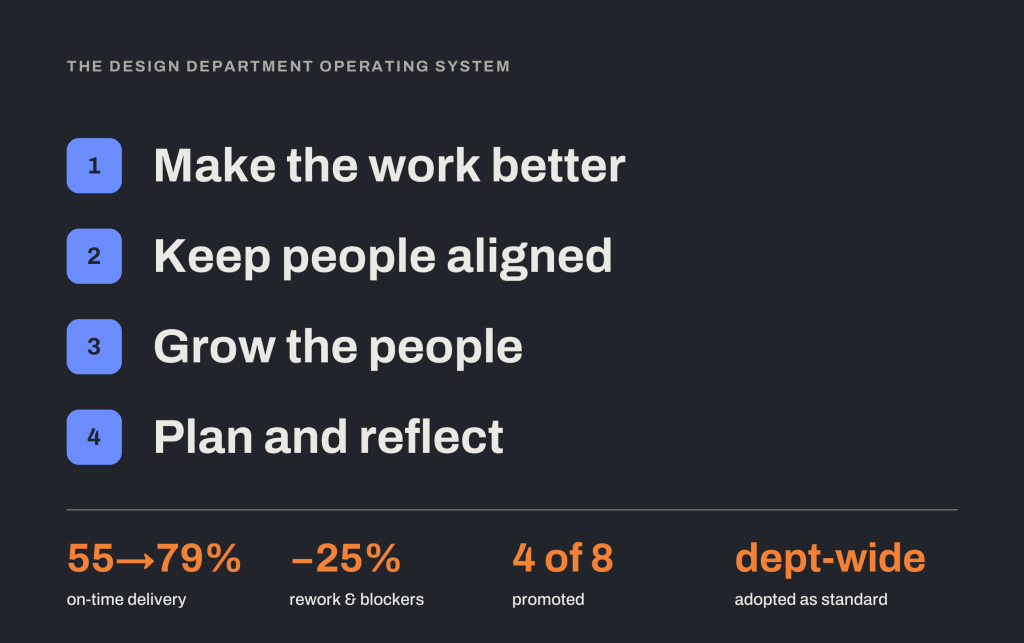
What are the specific rituals?
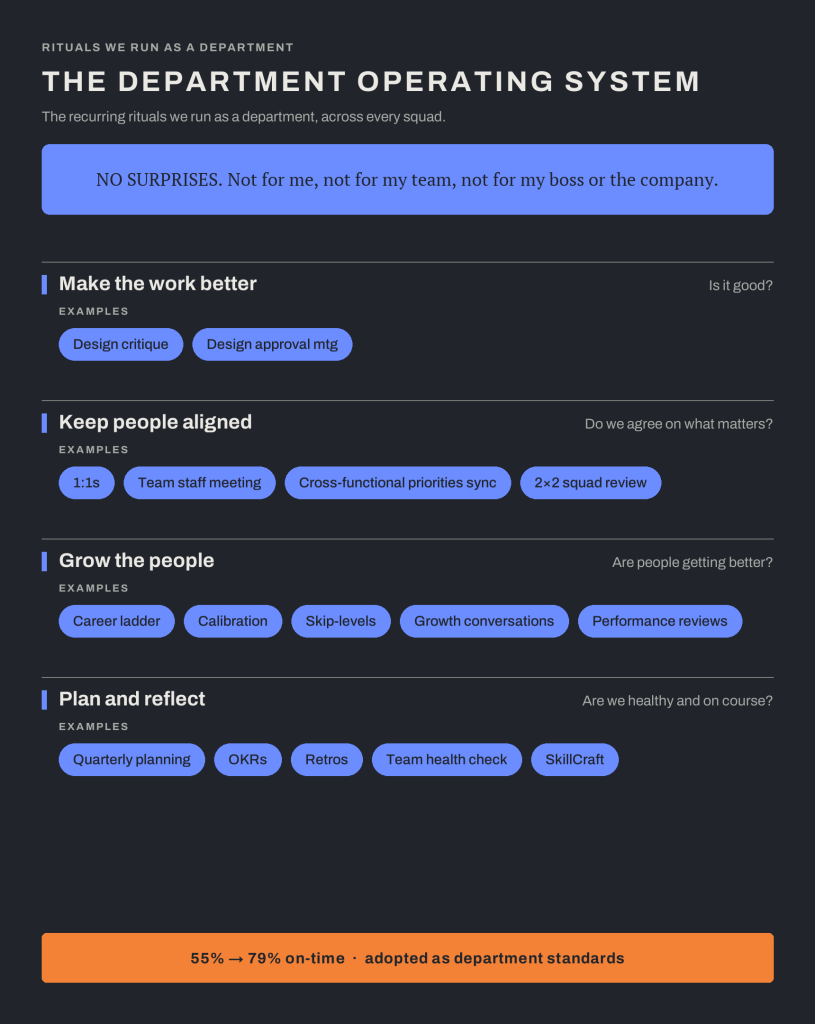
55% -> 79% On Time
Predictable delivery of committed scope across 5+ squads
~25% Less Rework
Clarity removed design-to-dev rework
4 of 8 Promoted
Direct reports up-leveled or advanced (in a turnaround with 3 org reductions)
Departmental Adoption
Adopted by 3 design divisions (still running a/0 2027)
Our Operating Goal: NO SURPRISES
- Clear, shared priorities
- Just enough system
- Principles & process are embedded in the artifacts
2. The tactical-level rituals/methods in the Feature Development Lifecycle
The immediate problem
*Drag the center divider left or right to compare the before and after
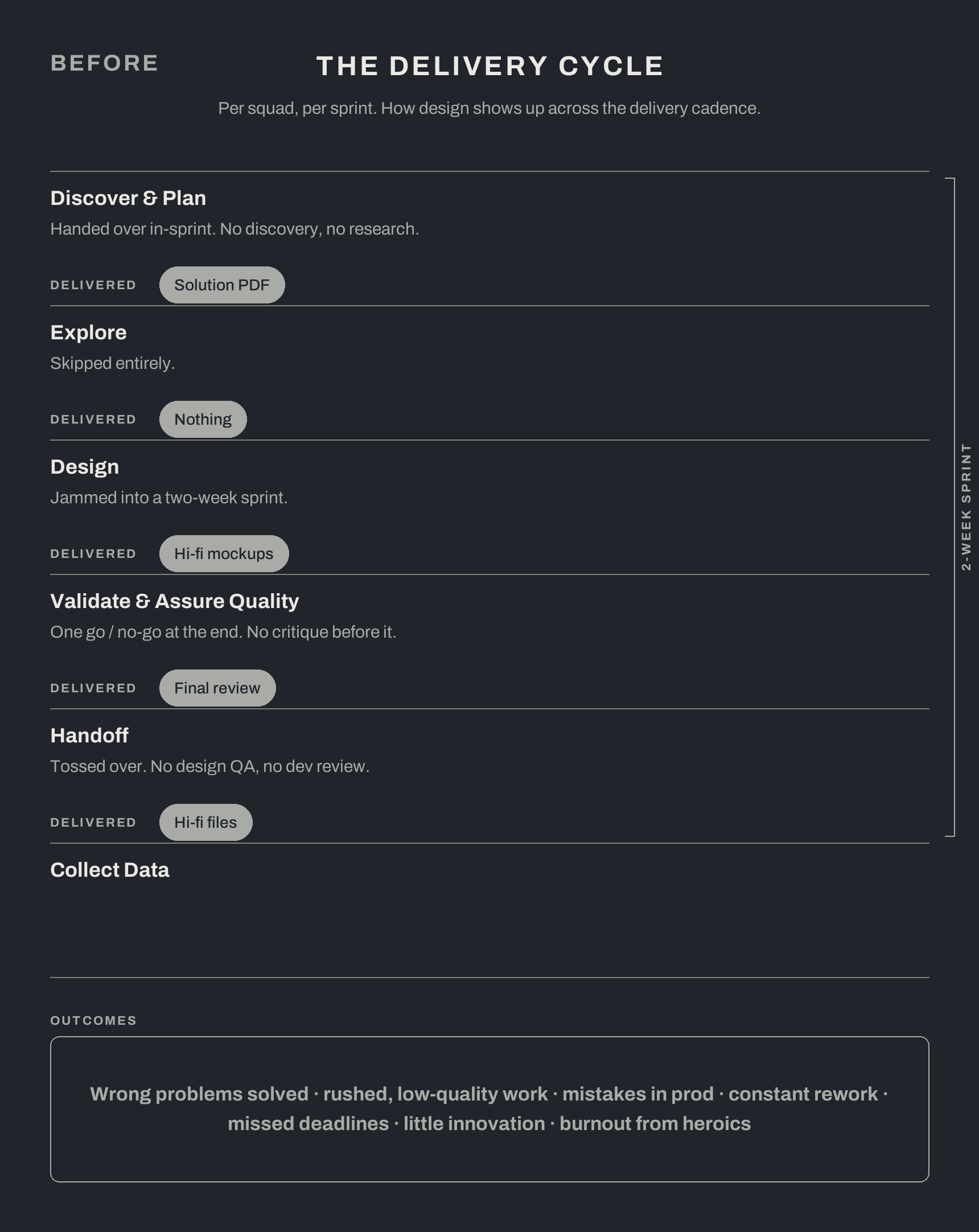
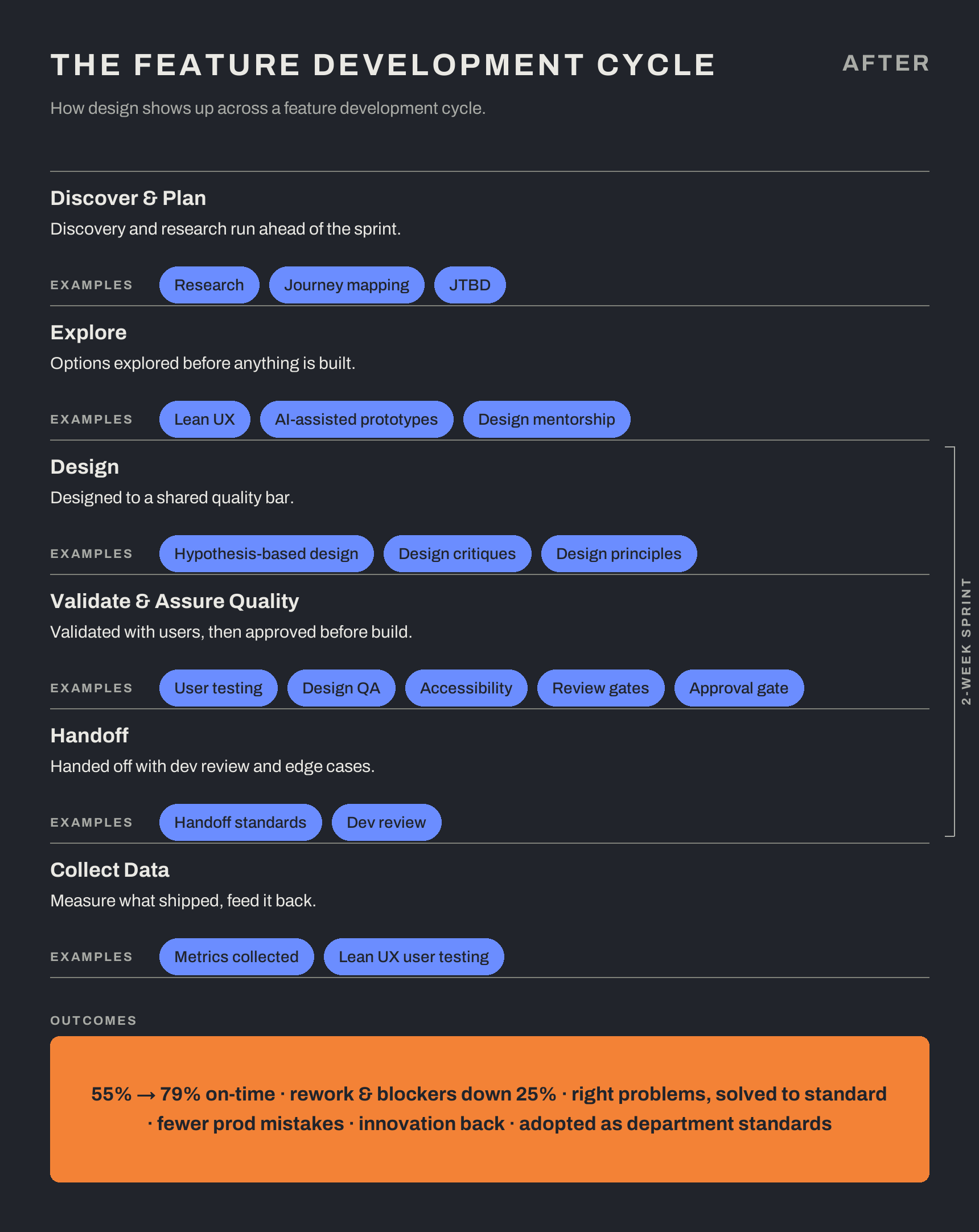
*All activities are representative, not exhaustive
Project Summary:
- The Ask: level up a design division so “design moves faster”
- The Problem: design was pulled in at build time; no shared operating model; every squad did things their own way
- The System Fix: quick, high-value rituals and methods first, under fire; –
- Later: polished into a best-in-class operating system
- The Output: the feature design cycle’s rituals and craft standards, from critique and gates to hypothesis-first design
- Later: Best-in-class departmental OS and a cross-org upskilling program
- The Outcomes: on-time delivery 55% to 79% | rework and blockers each down 25%
- Later: Operating system adopted by all three divisions | still used today
Company Context:
Pluralsight is a multi-sided enterprise learning platform
- ~500,000 active learners
- ~$400M ARR
- ~1,900 employees
- A design department spanning three divisions
- My Team: 5+ delivery squads, product-area scope 6 to 12 product surfaces
Problem: design was relegated to a tactical implementation function only, with each squad running their own processes.
Operating Context: Third year of a turnaround, so no added headcount and three org reductions in the past. One of three design directors under the VP of Design. Partnering with five division leaders and 6 to 12 delivery teams across engineering, design, and product.
Design delivery ran on heroics
- Design pulled in at build time, not at planning
- On-time delivery stuck at 55%
- Rework and cross-team blockers eating lots of capacity
No shared way of working
- Each squad has its own cadence and quality bar
- Design department (3 divisions) couldn’t improve as one
- No common path for growing skills
1 Designer: 3 Dev Teams
- Working with an outside offshore engineering consultancy
- Design to dev ratio at 1 designer:~30 developers, or 3 dev teams for each designer
(Ask me about guiding a last-minute engagement with offshore engineering consultants)
“I feel so stupid about missing this deadline – this [first] team does things completely different from [the second] team and certainly is more lax than [the third team]. I’m so confused all the time.
Also – shouldn’t someone have caught this in the meeting last Thurs – the one that should have been but wasn’t a sprint planning meeting? I don’t think this team even has planning – I know they don’t have stand ups. How is anyone supposed to know what anyone is doing or should be doing?“
– Slack message from a designer
I got my boss’ buy in to create an operating system that all of design could use, using my own squads as a test to prove the value. But focusing on ‘standardization’ does have risks.
- Creating processes only my own squads could use risked looking like the bottleneck.
- Standardizing across squads, divisions and cross-functional partners, with true buy in, is a difficult change-management challenge. In a turnaround, it takes time away from the fires we’re putting out.
- Designers and squads were stretched thin – would processes be more work for them?
I was the right leader for the job because I’ve built and rebuilt design functions before, so I had the frameworks, playbooks and models. I could – and did! – prove the model worked with my own squads. My craft standards were what the VP of Design, our designers, and our partners wanted.
I believe a big part of my job is to help create the systems that enable people to do their best work.
Playbook: I quickly fixed delivery with high-value rituals and set craft standards inside my division, proved it worked, and then did the hard work of advocating for a coherent system across the company
What I Did
- Fixed delivery first (and under pressure)
- Scope the rituals and methods into a cadence that fit our capacity
- Set best-practice craft standards
- Use my team as example of outcomes
- Developed best-in-class departmental operating system
- Rituals on a predictable cadence
- Institute systems to develop designers
- Change management aligned disparate squads into a unified operating model
Tradeoffs: At what cost?
Who made a change, and what did it mean to them?
- IC designers:
- Start with hypothesis-based design, quickly communicating purpose (vs start anywhere)
- Lo-fi, messy work shown early for feedback (critique is a core competency of designers)
- Senior designers: Institute readiness gates and a unified quality bar (elevating them with important mentorship opportunities)
- Cross-functional leaders & all squads: Their own processes, cadences and quality bars replaced with a shared system
High-level Department Rituals:
The tactical-level rituals/methods in the Feature Development Lifecycle:
For the initial processes and rituals:
- Co-created the delivery rituals based on our actual capacity balanced with desired outcomes.
- Collected metrics to prove the impact
- Cross company alignment (change management) and voluntary standardization
In addition, I recognized the vulnerability of learning and applying radically new skills in a company already running org reductions.
- I rewarded learning over polished demos
- I kept track of and addressed the human concerns
- Managers/ Staff designers, product, and engineers were enabled and trusted, so they functioned as strong partners in the adoption work
Results: The operating system took on-time delivery from 55% to 79%, cut rework and blockers 25%, advanced 4 of 8 of my reports. Today, this system is run by the director I developed.
Outputs:
The department's ritual operating system
A library of different methods (grouped by outcome)
A competency ladder plus peer calibration
A cross-org upskilling program (Skillcraft) with OKRs and a franchise playbook
Outcomes:
Voluntary cross-org adoption of the upskilling program (Skillcraft)
On-time delivery 55% to 79%; rework and blockers each down 25%
Adopted across the department (three divisions) for all projects
4 of 8 direct reports promoted
I don't know how you knew what we needed, but I'm glad you jumped in right away.
The processes we have now are so much better than the chaos we had before. I know it was hard work to get everyone on board, but it's so worth it.”
– M.S, Offshore consultancy partner
Current Status (a/o Q4 2026)
- The ritual operating system is still how the department works.
- The director running it is someone I developed and promoted.
- The rituals and methods are documented and in use, so the team can spend its time on the most important work.
I build senior capability by handing people the work one level above them, with cover.
- Several senior designers stepped up to mentoring our jr designers, extending our capacity greatly and proving their Staff skills
- The design-system lead became the in-house expert and built reusable systems the rest of the department adopted
- A director, once a manager I developed, now runs the design department
Lesson: I couldn't order cross-functional teams to standardize, so I fixed my own team's pain and built a scalable system people could easily opt into
What do you do when you don’t have the authority to require cohesion?
The Constraint: no cross-company mandate to standardize
- No buy-in from the company, just a lot of chaos and confusion
- It’s risky to ask for people’s time on operating-model work in a turnaround, on my boss’s priority alone
What I did instead: proved it worked and made it scalable
- Fixed the immediate delivery pain first, with my own team
- Gathered metrics and proof this was better
- Good change management to get buy-in
- Created rituals and methods that I know were valuable and could scale
- Make the system cheap and easy to adopt
How I knew it worked: The other two divisions adopted the operating system without being told to, and the director who replaced me still runs it today.
Project Information
Building a Design Department’s Operating System
Building the operating system a design department runs on. The Proof: adopted by all three divisions, and still used today.
-
Design
Built and run across the platform rebuild, 2024 to 2026
-
Client
Pluralsight. B2B SaaS, EdTech. ~ 1,900 employees.
PE-backed, in stabilization. -
My Role Then
Director of Product Design, then Director, UX Product Design and Research. One of three design directors under the VP of Design.
-
Scope & Span
5+ delivery squads, product-area scope 6 to 12, across a three-division design department.
-
Team & Reach
15-person org (8 direct, 2 managers). One of 3 divisions under the VP of Design. Delivery done in pods.
-
Platform Type
B2B SaaS, multi-sided (Enterprise admin, individual learner, internal authoring)
-
Status (a/o Q4 '26)
The ritual operating system still runs the department, under the director I developed.
-
Tags
Change Management, Governance, Operating Model, Team Capability, Transformation