

Shaping Vision and Strategy Across the Org
-
Design
Done Q1 2025 over 3 sprints (6 weeks)
-
Client
Pluralsight. B2B SaaS, EdTech. ~ 1,900 employees. PE-backed, in stabilization.
-
My Role Then
Director, UX Product Design and Research, Learning Experience. Reported to the CPO.
-
Scope & Span
Search, Browse, Home, Navigation. Discovery surfaces reach 80% of platform users.
-
Team & Reach
15-person org (2 managers). Aligned 5 Divisions at the leadership level and 6+ delivery teams (engineering, design, & PM).
-
Platform Type
B2B SaaS, multi-sided (Enterprise admin, individual learner, internal authoring)
-
Status (a/o Q4 '26)
In production at www.pluralsight.com; roadmap investment across 5+ divisions for 2025 & 2026 (est 2027)
-
Tags
Cross-Org Alignment, Decision Frameworks, Platform Coherence, Vision
Creating a company vision and strategy for a coherent experience across a multi-sided SaaS platform
I refused the redesign and asked, “What’s this Home page for?” proactively influencing the company’s product decisions before commitments were made
How a one-sprint page redesign, already approved, became a four-surface roadmap item and a funded 2025 & 2026 investment for five divisions.
Impact:
The Pluralsight platform has ~500,000 active learners with ~$400M ARR. The discovery surfaces I owned reach 80% of them, on a search API handling ~4.4M queries a month.
45% -> 84% Engaged
Clicked the most critical content immediately
Learners found their most critical next action
+370% B2B Reach
More unique learners clicked assigned content
Many more B2B learners found the most critical content
36.4% -> 55% Start
Platform content start rate (action on first click)
Learners clicked once and got right to work.
Before
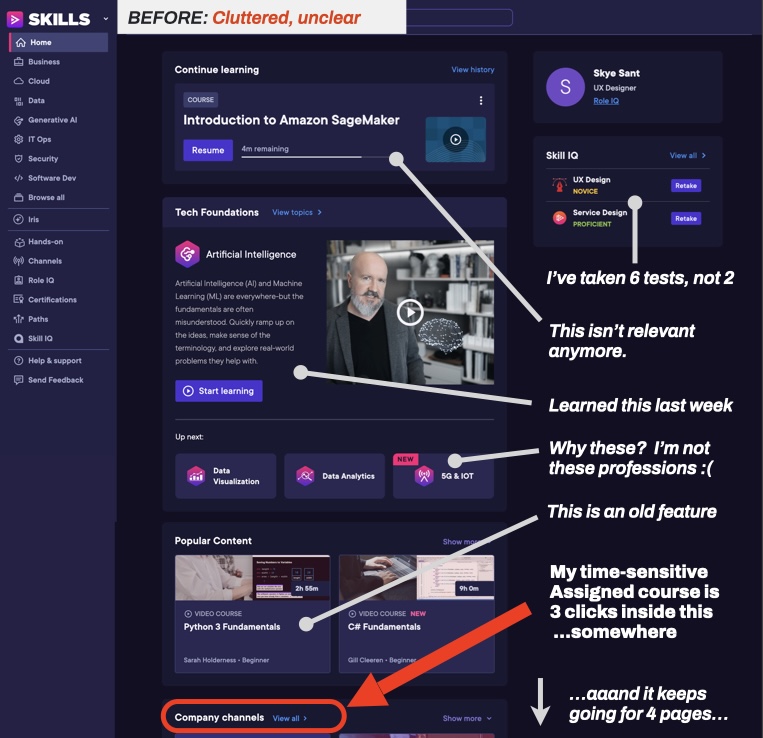
- A cluttered home page, with every content type everywhere.
- Assigned Content (what companies pay us for) is obscured.
- Company in conflict
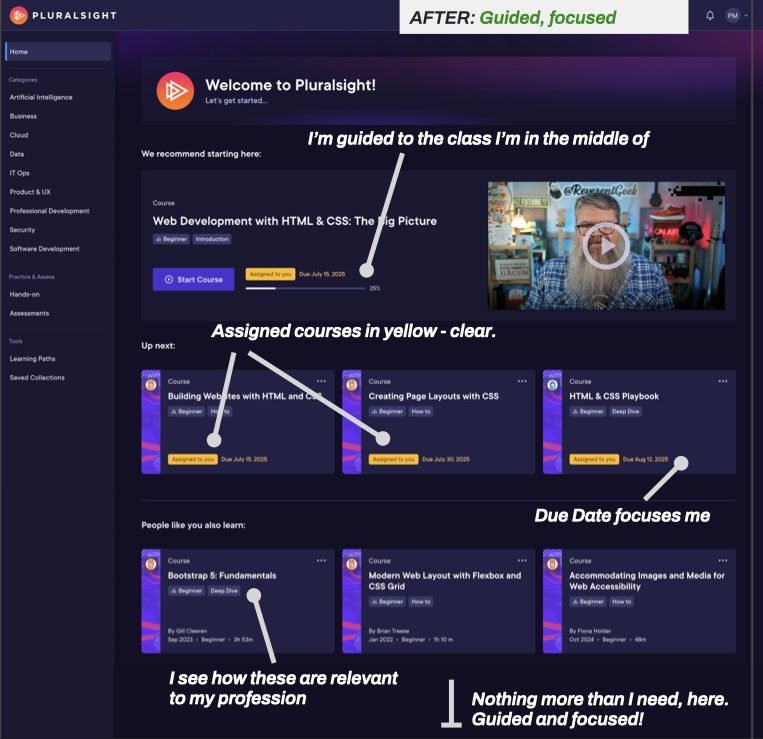
After
- Learners see the most relevant next action before reading a word.
- /Criticality/ drives the layout instead of content type.
- 5 divisions in alignment.
I made the call to delay a one-sprint redesign and spend three sprints doing it properly, leading the executive team and the rest of leadership through a vision exercise – against real pushback – and using the Home page redesign to prove the vision and strategy worked.
The home page was the symptom. Reading the real issue as being a system problem, and being able to justify this additional time/effort, under pressure, is why I was the right leader.
North Star Vision:
We will deliver a focused and expertly tailored experience that guides learners to efficiently discover the most relevant content for their needs.”
Problem:
Operating Context: Third year of a turnaround. No added headcount, three org reductions behind me. Reported to the CPO. Partnering with five Division leaders and 6-12 delivery teams across engineering, design, and PM. A platform serving roughly 500,000 active learners, and a discovery surface reaching 80% of them.
Engagement & Retention Down
- Companies pay us to assure Learners do assigned content
- Learners can’t find their Assigned content
Cross-Division Company Conflict
- No shared purpose for Home
- 5 divisions competing for space
Playbook
- Vision Workshop (3 days, 5 division leaders + Executive team)
- Strategy: easily applicable ‘Criticality’ framework
- Home page redesign
- Lean UX/user validation testing
Five Division leaders each owned part of the page, and the ask was removal, not addition. In the third year of a turnaround, page space was one of the few visible wins their teams had left.
I also had to tell the executive team that the one-sprint redesign they had already approved was not happening, then hold three sprints with nothing shippable while everyone was clamoring for production designs.
Leading with each leader’s OKRs before asking for anything is what turned removal from a loss into their decision, and turned a page redesign into a shared, org-wide vision with roadmap investment behind it.
Playbook:
Tradeoffs: What came off the page, and who gave it up
- Assessment team. Pre/post test results moved to the Assessment landing page.
- Hands-On and Labs. Engineering course recommendations moved to Software Development.
- ML team. Recommendations capped at the top 3 to 5 per learner.
- All five Divisions.
- Feature advertising moved to each content type’s own landing page.
- I was assigned Home page’s owner
- New information architecture for Navigation, Home, (Content) Landing Pages
Results:
Mitigate the Risk:
To assure our riskiest bet was sound, we ran a quick Lean UX validation round with 10 users. Validated before rollout: 6 of 6 task success, 6.8 of 7 ease, 66-second average completion.
5 Divisions aligned on a shared North Star
Home Page that's 'guided and focused'
I was made owner of the Home page
Shared Vision across 5 divisions
Guided experience across 5 product surfaces
I mean, I really wasn't a fan of taking time away from production to 'draw on the wall'...
But I gotta admit - in this company, I've never been working in a room with that many leaders, together.
And the results speak for themselves. ”
– E.L. , Senior Content Operations Leader
UX Outcomes: Life Improved
- By making criticality drive the page instead of content type, we improved the enterprise B2B learner’s life (and every other learner persona) by replacing a scan of forty options with one obvious next action.
- By surfacing assigned work at the top of Home, we improved the enterprise B2B admin’s life by making the learning they assigned actually get started, without chasing their teams to do it.
- By publishing one rule for what earns space on the page, we improved our company’s experience by giving every team a defensible answer to “why isn’t my widget here?” that they could apply inside their own planning.
Current Status (a/o Q4 2026)
- “Guided and Focused” is the current experience principle governing Home, Search, Recommendations, and Navigation
- Rolled out to active users (results as noted)
- Changes/ improvements receiving roadmap investment across 5+ divisions for 2025 & 2026 (est 2027)
I build senior capability by handing people the work one level above them, with cover, using my own projects as the vehicle so they get to work directly with me, division leaders and the executive team on something that matters to the business.
- A junior designer co-facilitated the design sprint with me, so facilitation became a capability for her and her team.
- A manager on my team carried this vision and the Home redesign at board level and was promoted to Director.
Lesson:
What did I get wrong here, and where did I fix it?
One All-Hands is not enablement
In a rush, I treated the enablement – helping teams understand how to apply the vision and strategy inside their own product areas – as communication. I announced the vision at a Product All Hands…
…but teams who weren’t in the room didn’t have what they needed to apply the vision to their own areas, so I had a lot of 1:1 meetings to redirect the teams working on our shared surfaces.
Not a good use of anyone’s time, and far too reactive for teams moving fast.
Build the strategy into existing processes
On the next project, B2B Analytics Page, I announced the vision, the framework, and then built it into the documents and rituals where decisions already happen. This looked like:
- Eisenhower matrix in the default Discovery doc
- A checkbox in roadmap intake.
- A qualifying question asked of every feature in quarterly planning.
Teams had the guardrails in their own workflow (not a slide, ha!). It showed up in team work and roadmap proposals before design was in the room.