I built the standards, workflow, and governance that moved a 15-person design org from ad hoc AI use to 96% voluntary adoption.
Goal: a shared, governed way for a 15-person division to use AI in design (before AI-generated design reached the product without guardrails)
Task: I wrote the standards, workflow, and governance for AI-augmented design before Pluralsight had any, which took design exploration from 2+ weeks to 3 days and put 96% of us on a shared workflow.
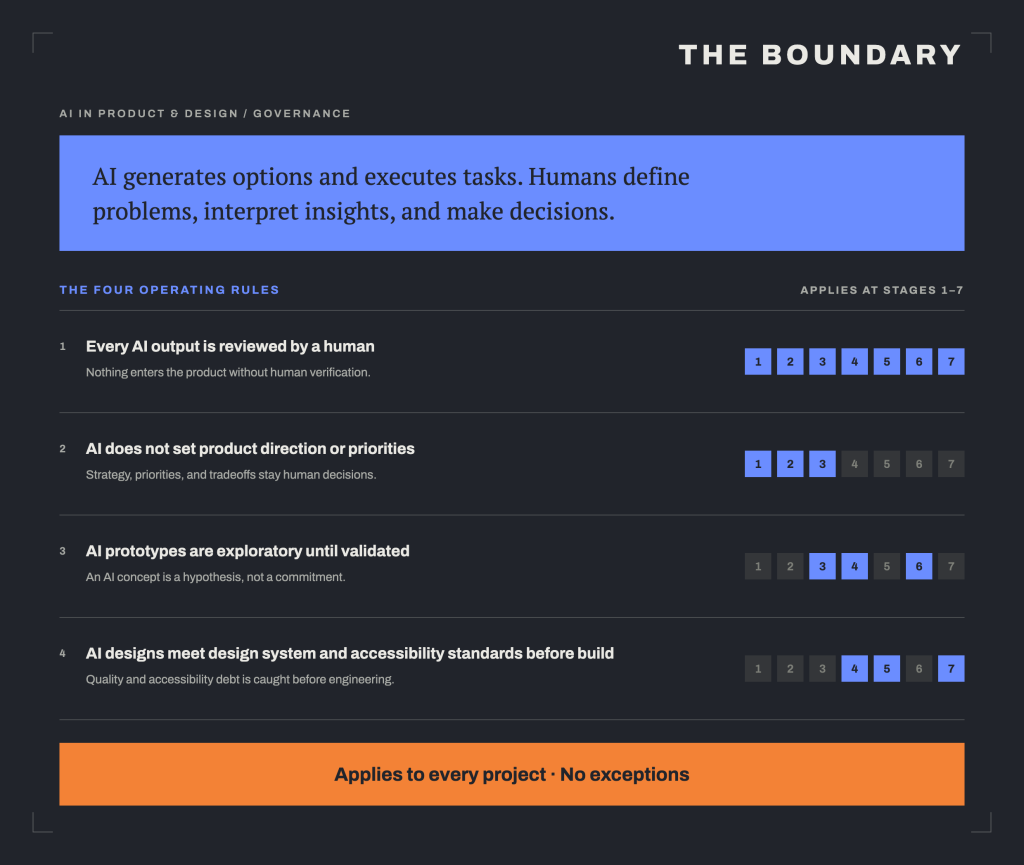
The Boundary:
AI is your partner: it generates options and executes tasks. Humans define problems, interpret insights, and make decisions.
2 weeks -> 3 days
Feature development cycle
~$830K saved
Annual labor cost avoided
96% adoption
Voluntary, across a 15-person design org
Company Context:
The Pluralsight platform is a multi-sided enterprise Learning Platform (~500,000 active learners | ~$400M ARR)
- 15-person Learning Experience design org (8 direct reports to me)
- 6 IC designers and researchers
- 2 managers
Project Summary:
- The Ask: None. Every person was on their own re: AI use
- The Problem: AI was reaching the product faster than design had standards for using it, and there was no guidance to inherit
- The System Fix: The Boundary (statement) | AI workflow (mapped onto the process we already had) | an ‘Operating System’ (OS)
- The Output: The standards (documented), prompt library, scope template, and enablement (for design first; eventually cross-org)
- The Outcomes: Feature cycle 2+ weeks to 3 days | 19 person-days saved per feature cycle | ~$830K annual labor avoided | 96% adoption | DesignOps, the design system team, PMs and engineers voluntarily adopted it
*Drag the center divider left or right to compare the before and after design workflow
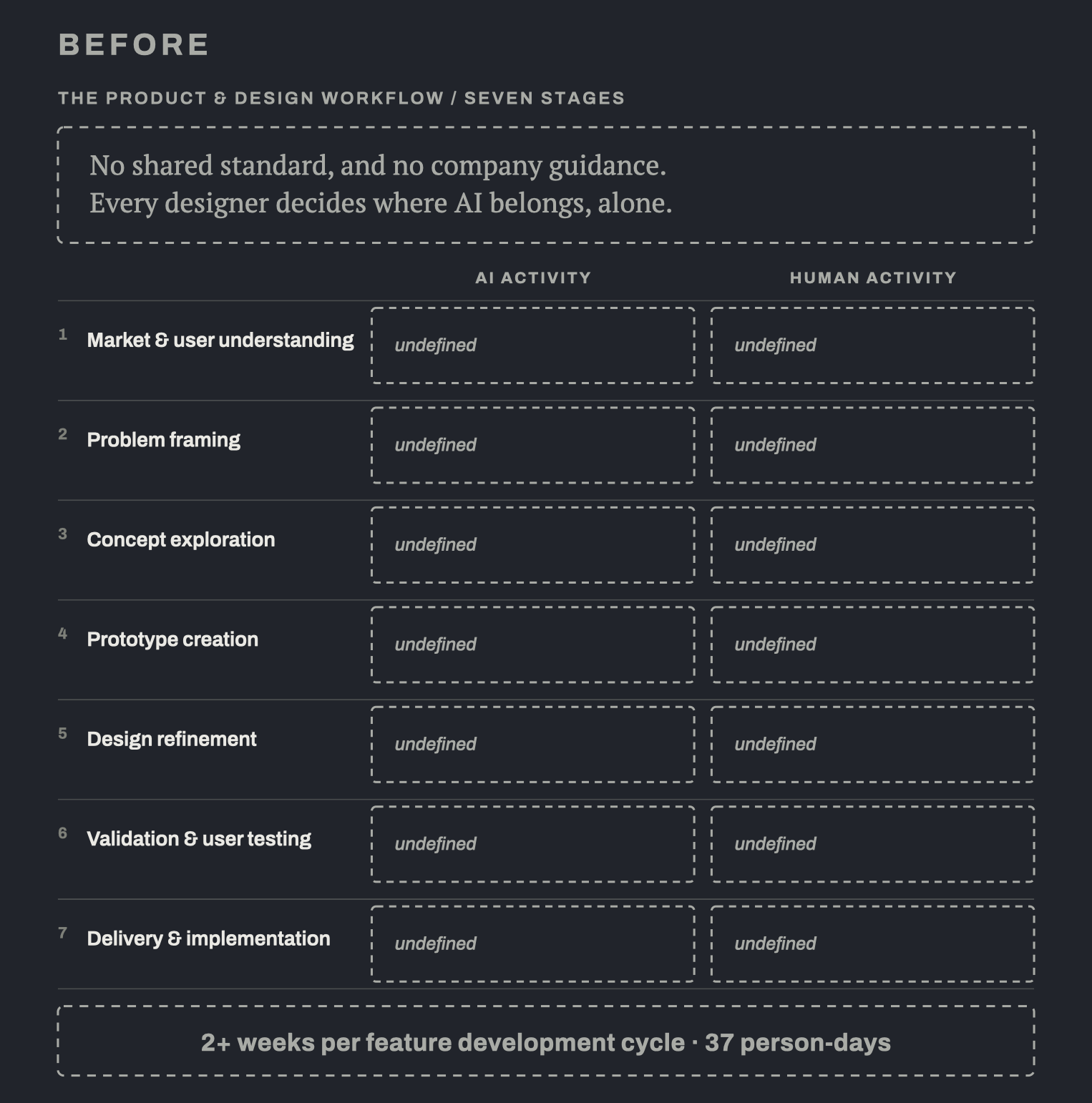
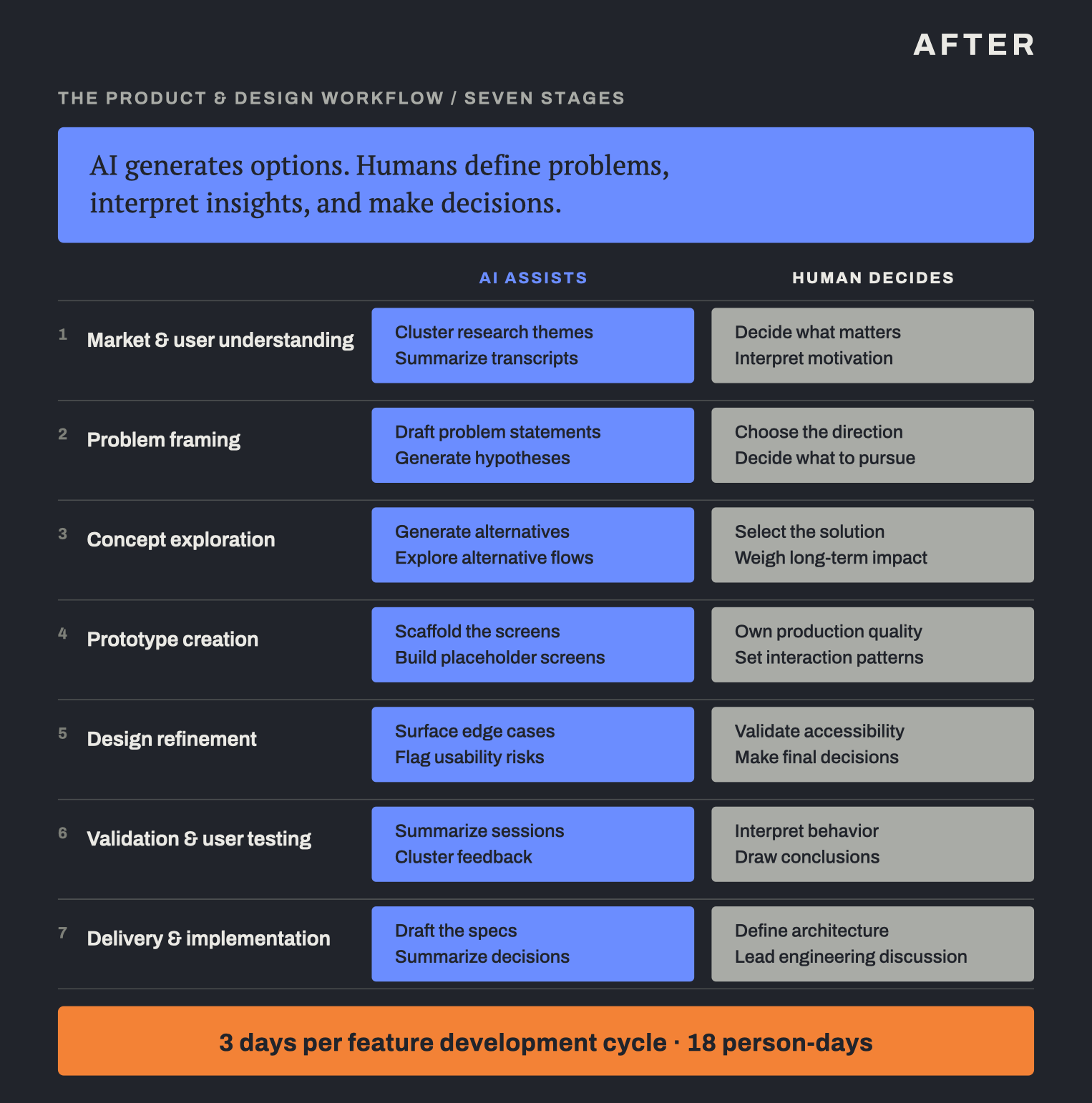
*All activities are representative, not exhaustive
Problem: AI was reaching the product faster than design had standards for using it, leaving five teams to invent their own practices and quality bars.
Operating Context: Third year of a turnaround. No added headcount, three org reductions behind me. Reported to the CPO, co-directing the org with a PM peer. No AI standards, patterns, or workflows existed anywhere above me to inherit.
5 Design Teams 'winging it'
- Some designers experimenting, some avoiding it, some using it quietly
- No consistent way for a manager to set an expectation
- No quality checks
Lack of cohesive governance
- No AI standards existed above me to inherit
- No forum where AI decisions were being made across functions
- No one leading or enabling
AI adoption is 80% leadership, behavior, and operating system. The tools don’t create value on their own, so it’s not “which AI tool should we use,” it’s “which workflows should we improve, what guardrails do we need, and how will we know this is working”
– from Section.ai training
“It’s important that we treat AI resistance as information, not defiance.”
– Slack message to my managers and staff designers
First, bad AI-generated quality would impact client and internal colleague trust and reputation. Quality of the platform is my responsibility; creating systems that assure good work is my job.
Second, the Team’s fear and resistance around AI was negatively impacting people and the work. The designers were being asked to put a tool in the middle of their craft loop, and not being enabled to understand why or how. The Boundary (statement) gave them meaning and direction on how to partner meaningfully with AI
Lastly, because there was no company governance to take direction from, I was doing unsanctioned work. My boss was very happy to support me, and I published everything transparently and often so the business could see what I was doing.
I was the right leader for the job because I believe in jumping into innovation and my job is to help create the systems that enable people to do their best work.
Playbook: I set the boundary between AI and human judgment, mapped it onto the existing design process, and built governance that made voluntary adoption possible.
What I Did
- Created ‘The Boundary’ for actionable guidance
- AI use mapped to our 7-phase design process
- An AI Operating System (AI OS) [In-depth case study coming soon]
- Governance layer (opt in)
- AI Enablement Plan & Documents
“We use AI to remove avoidable friction from design work, increase the quality of our thinking, and make more room for the human judgment that users and the business actually need.”
– from ‘The Purpose of AI in Design’
Tradeoffs: At what cost?
- IC Designers:
- New capability: A craft practice involving UI screens replaced by AI augmentation
- Rough-but-adequate work visible at 3 days instead of perfect work at 3 weeks
- Leaders & UX Managers:
- New processes and enablement necessary; no added headcount or time
- Need to be advocates, so ahead of the curve and share an AI vision
- Production Teams: learning new practices without officially added time or space for it
- Clear purpose and uses of AI
- Clear guidance re: what humans were (still and always) responsible for.
- Classification of feature development projects into clear types – more risks required more effort.
- Acknowledgement (in meetings, critiques, and written on the prototypes) that visuals produced were ‘proof of concept’ (POC) work. Visuals looked hi-def but it did not represent all of the necessary thinking.
- Encoding the design system into Figma Make and Claude is what brought the design system team into the work – and greatly improved quality out of the gate [case study coming soon]
In addition, I recognized the vulnerability of learning and applying radically new skills in a company already running org reductions.
- I rewarded learning over polished demos and showed failed experiments, including my own
- I kept track of and addressed the human concerns [case study coming soon]
- Managers/ Staff designers were enabled and trusted, so they functioned as strong partners in the adoption work
Results: The AI operating system reduced the feature development cycle from 2+ weeks to 3 days, avoided ~$830K in annual labor cost, and reached 96% voluntary adoption across product, design, and eng.
Outputs:
AI The standards, workflow, and governance
The design system encoded into Figma Make and Claude
Supported AI practice (cross-org and voluntary)
First spec-driven design spike w/ Eng
Outcomes:
Voluntary cross-org adoption
Innovation Capability Unlocked
Metric gains: time, money, efficiency
Truth is, I was avoiding it.
AI was too much, too fast, and so out of my control... but now I'm teaching other people, and I see so many possibilities.
Turns out I just needed a little help and a firm push :)”
– S.P., Senior Designer
The most critical quality bar: AI-supported work must be better, faster, clearer, or safer.
If it was only more automated, it was not enough*. Every workflow we scaled had to answer yes to one of these:
- Improved the quality of thinking
- Accelerated clear and bounded (repetitive, admin) tasks
- Reduced avoidable rework
- Preserved user trust
- Made sources and assumptions clearer
- Protected the judgment design is accountable for
*Genuine AI augmentation requires durable net value; if apparent productivity gains are swallowed by verification, exception handling, rework, recovery or cognitive burden, it means we moved the work around, we didn’t create real efficiencies.
Current Status (a/o Q4 2026)
- By May 2026, all of design (3 divisions), almost all of product and several engineering teams were working AI-augmented
- July 2026: AI augmentation is mandatory for design, product and engineering
- My frameworks, assets and training programs are still in use
I build senior capability by handing people the work one level above them, with cover, using my own projects.
- My managers set expectations with their teams and served as the enablement & advocacy layer, building team trust, autonomy, and executive presence by running a project with all the assets built-in
- Design Systems team became the in-house expert and created impactful /skills and Figma Make systems
- 2 staff designers leaned into building /skills and became advocates and coaches for their project teams – is is part of how it reached functions I had no authority over
Important Note:
The 2 weeks -> 3 day efficiency did not increase the number of feature development outputs per designer.* I reported this to my CPO alongside the many wins.
- What it bought was decision speed and a lower cost of being wrong before development.
- What took it’s place was additional demands for ‘quick POCs’ for purposes other than feature production (for instance, PM demos to customers)
* In other words: Jevons Paradox or the Rebound Effect in action.
Lesson: With no company appetite for AI standards, I governed the design practice I owned and built a system other functions could adopt voluntarily.
What couldn’t I change, and what did I do instead?
The Constraint: no company appetite for AI standards
- No buy-in from the company. My boss’s sanction was the only cover I had.
- Asking designers for time on unofficial work, in a turnaround with three org reductions behind us.
What I did instead: governed & championed the one practice I owned
- Wrote the standards for my own department, documented voraciously
- Enabled while inspiring, so we were working from a position of possibility (not force)
- Built governance and processes so any function could adopt them without a mandate, and without me.
How I knew it worked: My designers became the people teaching this on their product and engineering teams, and people across the org voluntarily joined us.
Skye’s Protip:
To anyone about to embark on AI transformation (any transformation, really), my top advice is consider whether you’re creating centaurs or creating reverse-centaurs.
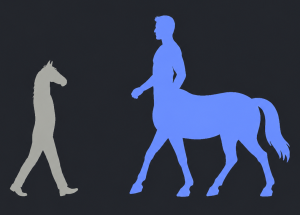
“When techies describe their experience of AI, it sometimes sounds like they’re describing two completely different realities – and that’s because they are. For workers with power and control, automation turns them into centaurs, who get to use AI tools to improve their work-lives. For workers whose power is waning, AI is a tool for reverse-centaurism, an electronic whip that pushes them to work at superhuman speeds. And when they fail, these workers become “moral crumple zones,” absorbing the blame for the defective products their bosses pushed out in order to goose profits.
As ever, what a technology does pales in comparison to who it does it for and who it does it to.”
– from The Reverse Centaur’s Guide to Life After AI: How to Think About Artificial Intelligence Before It’s Too Late. Cory Doctorow, June 2026, Farrar Straus and Giroux (US) / Verso (UK).
Project Information
Building an AI-Augmented Design Practice
Building standards, workflow, and governance for AI-augmented design before the company had any. The Proof: 96% voluntary adoption.
-
Design
OS done Q1 to Q2 2026, four+ months
-
Client
Pluralsight. B2B SaaS, EdTech. ~ 1,900 employees.
PE-backed, in stabilization. -
My Role Then
Director, UX Product Design and Research, Learning Experience. Reported to the CPO.
-
Scope & Span
The Learning Experience design practice. Standards, workflow, tooling, governance, and enablement.
-
Team & Reach
15-person org (2 managers). Partnered with the AI Product Manager. DesignOps, the design system team, and PMs and engineers from several delivery teams adopted the workflow voluntarily.
-
Platform Type
B2B SaaS, multi-sided (Enterprise admin, individual learner, internal authoring)
-
Status (a/o Q4 '26)
Standards and workflow in use at handoff. Spec-driven design piloted with engineering.
-
Tags
AI Practice, Cross-Org Alignment, Governance, Operating Model, Team Capability, Transformation