I led the team that defined Pluralsight's 'AI Assistant' feature, creating the principles and patterns that later scaled from five product areas to all 7,000+ courses.
Goal: Define a category that didn’t exist – an AI L&D assistant our enterprise clients and our learners could trust.
Task: I led the team that defined what trustworthy AI meant and looked like (principles and design patterns) for an AI assistant across 5+ platform areas and later the entire catalog.
Project Summary:
- The Ask: put ‘generative AI functionality’ in the product
- The Problem: AI had no meaningful use case yet for L&D platforms (2023/24). AI hallucinations would ruin client trust. We didn’t know what was worth building or how to build it.
- The System Fix: Design principles for the why and design patterns for the how
- The Output: Iris. Launched in July 2024 with answers grounded in Pluralsight’s own library and the learner’s current activity, focused on what was most important to the learner
- The Outcomes: Cross-org standards and patterns | learner engagement | Innovation (Iris was one of the first valuable AI functions for L&D, and serves as a model for other platforms)
Company Context:
Pluralsight Skills is a multi-sided enterprise learning platform.
- A 7,000+ course catalog, reaching 514,054 active learners at peak
- ~$400M ARR (~3% of a fragmented market where no competitor holds more than ~8%)
- The company’s bet: Attract enterprises with 500+ tech employees (which retain at 82% against 67% for SMBs)
- Iris is enabled per enterprise plan, never per seat
5 Product Areas
->Whole Platform
A platform-wide standard for grounding, memory, privacy, and appropriate AI use
All 7,000+ Courses
Iris was infused into the entire platform
+2.5 Min More Engagement
Longer sessions by 2.5 min than average classes
Actual AI Tutor in production (a/o Aug 2026)
Problem: Pluralsight needed an enterprise AI product before L&D had a proven use case or shared trust patterns (especially preventing hallucinated technical instruction which would damage client trust).
Operating Context: Third year of a turnaround, three org reductions behind me. Director of Product Design, Skills, reporting to the CPO, with 8 direct reports. Partnering with Data Science and Machine Learning, who owned the models, and with the business strategy team on pricing. Net new standards and 0 -> 1 development necessary.
Creating a trustworthy AI function
- Enterprise clients were wary of an AI functionality in 2023
- Hallucinated teaching – especially of technical instruction – is a liability
- Client trust was at risk, and trust patterns weren’t yet standardized.
What's worth building?
- Every platform was adding chat, but none had shown how that added net/new value to the platform
- Nobody could say what a learning assistant should do
- No shared rules, no definition of what to build or how
“Iris has to be worth more than the free general-purpose AI our clients already have.
And it has to be based on something only we have.
- Our content: the library of content, plus our knowledge of the learner’s progress and aspirations (RAG over this)
- Learner context: where they are and what they’re doing right now
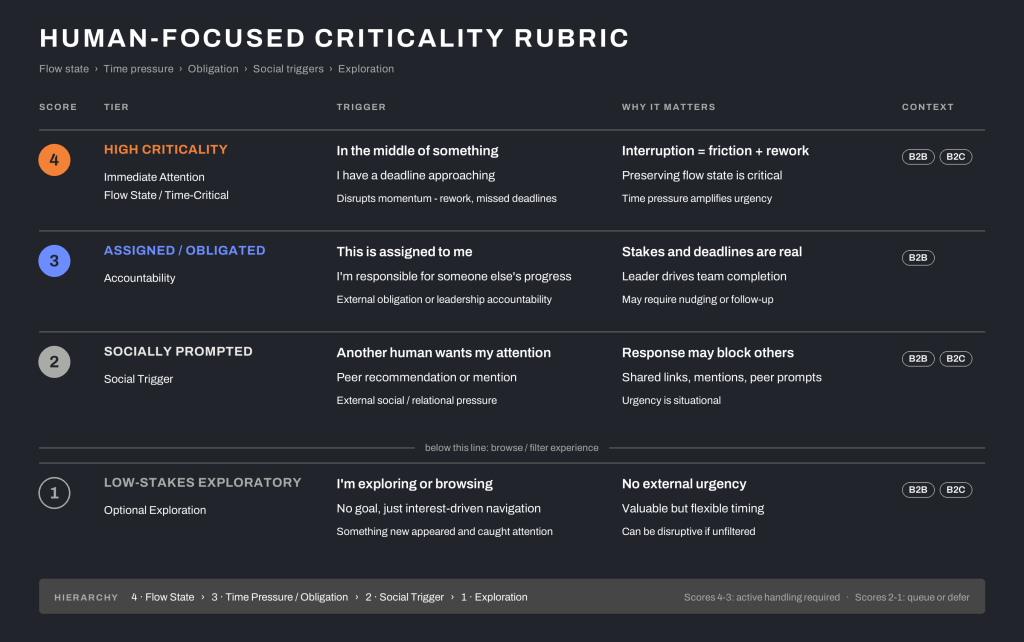
- Based on what keeps them in the flow: this is our Criticality Framework + the user’s values”
– from an Iris Team slack thread, re: creating Iris design principles
The company had recently decided to focus on enterprises with at least 500 tech employees (because they retain at 82% against 67% for smaller accounts) and GenAI was strategic priority 04 of 5 for 2024.
- Bad AI-generated quality would impact client and internal colleague trust and reputation. Quality of the platform is my responsibility; creating systems that assure good work is my job. The risk wasn’t just ‘ship nothing’, it was we’d ship a confident, plausible, completely hallucinating assistant into a new segment the whole 2024 strategy depended on, and lose the trust that made those accounts renew.
- There were no industry-wide AI patterns for L&D, but every product out there was shipping an AI chat. Slowing down to consider what we should do, for what user, to generate what value was a hard ask, but one that paid off in longevity and the stability of the patterns we created.
Why was I the right leader?
- I’ve built functionality that didn’t exist yet at every company I’ve worked in; at Coalfire I created a cybersecurity feature that produced new revenue pipeline, for instance.
- The Iris principle I’m proudest of – one that keeps Iris OUT of quizzes and assessments – came from training almost nobody in this company has: I taught physics and math in a previous profession, and protecting productive struggle is learning science.
As a past teacher, I knew it was important to construct Iris’s new patterns based on human psychology and good pedagogy.
*Drag the center divider left or right to compare the before and after designs for Iris
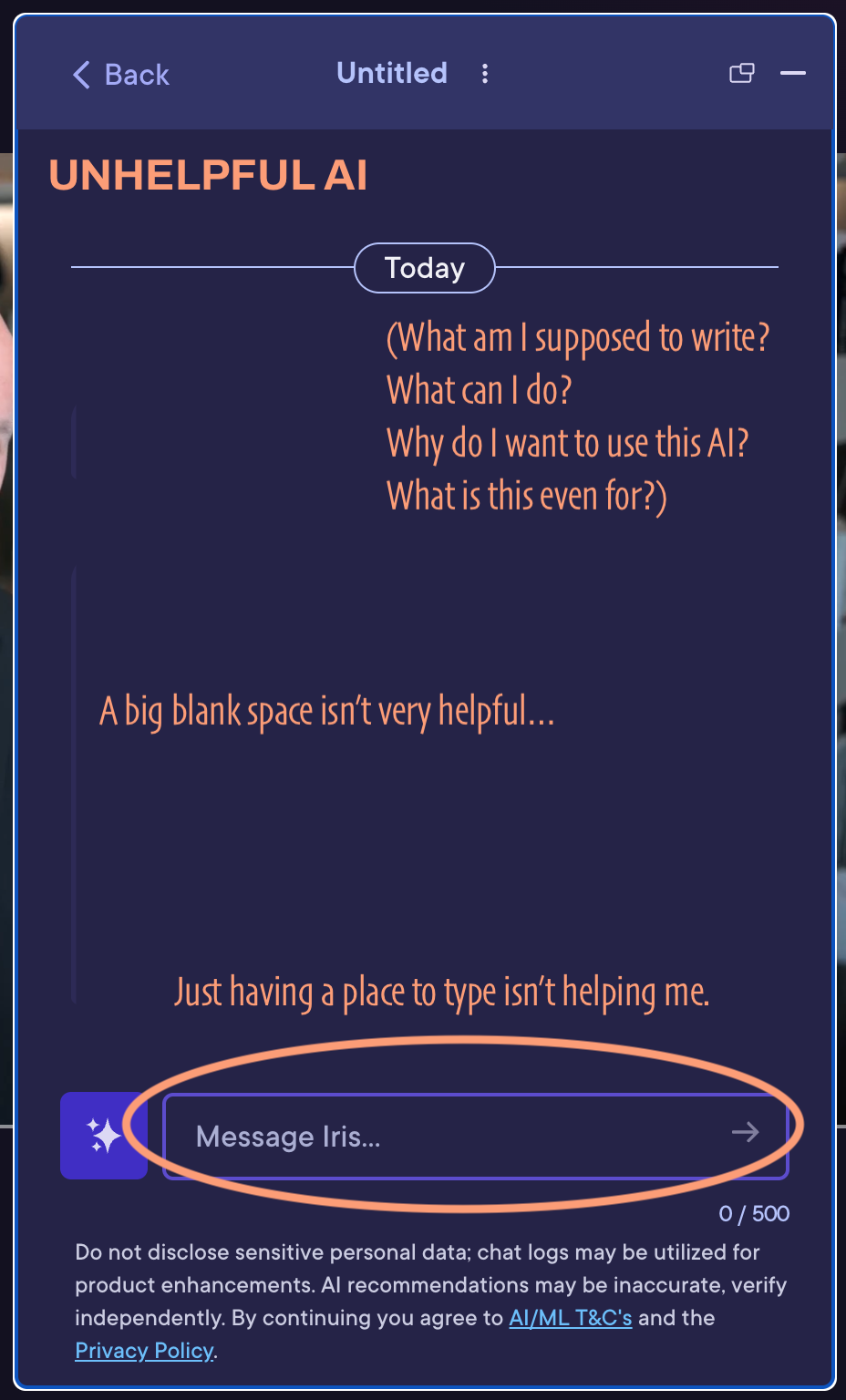
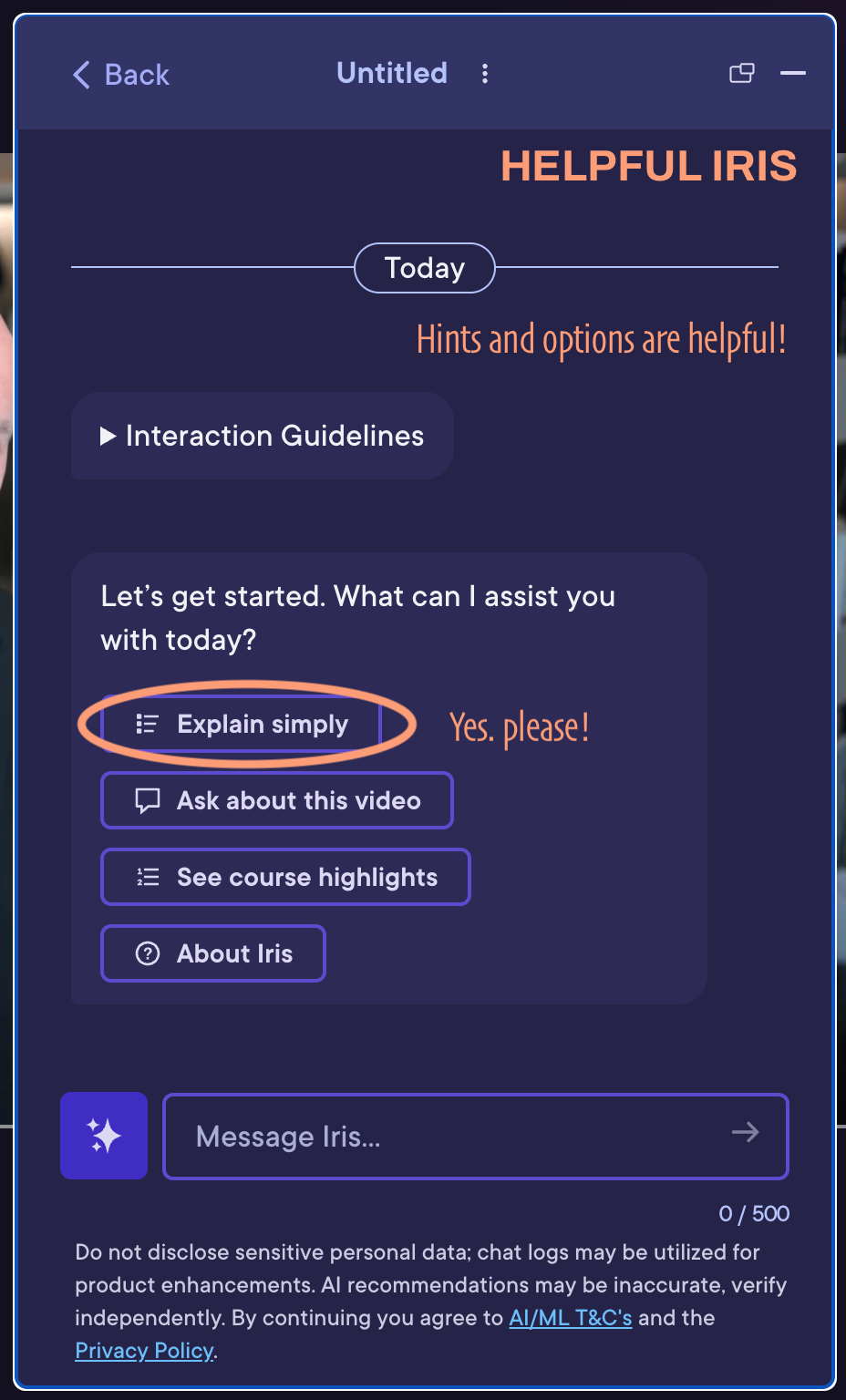
Playbook: I defined the value, principles, and patterns for Iris, staffed the work during a hiring freeze, and cleared away administrative friction.
What I Did
- Define the value/ use case (“What is worth building?”)
- Define the principles (“What is the experience like?”)
- Define the patterns (“How do we build it?”)
- Prioritize v1 functionality and prompts
- Staff the AI project (in a hiring freeze)
- Assure reach by clearing administrative hurdles
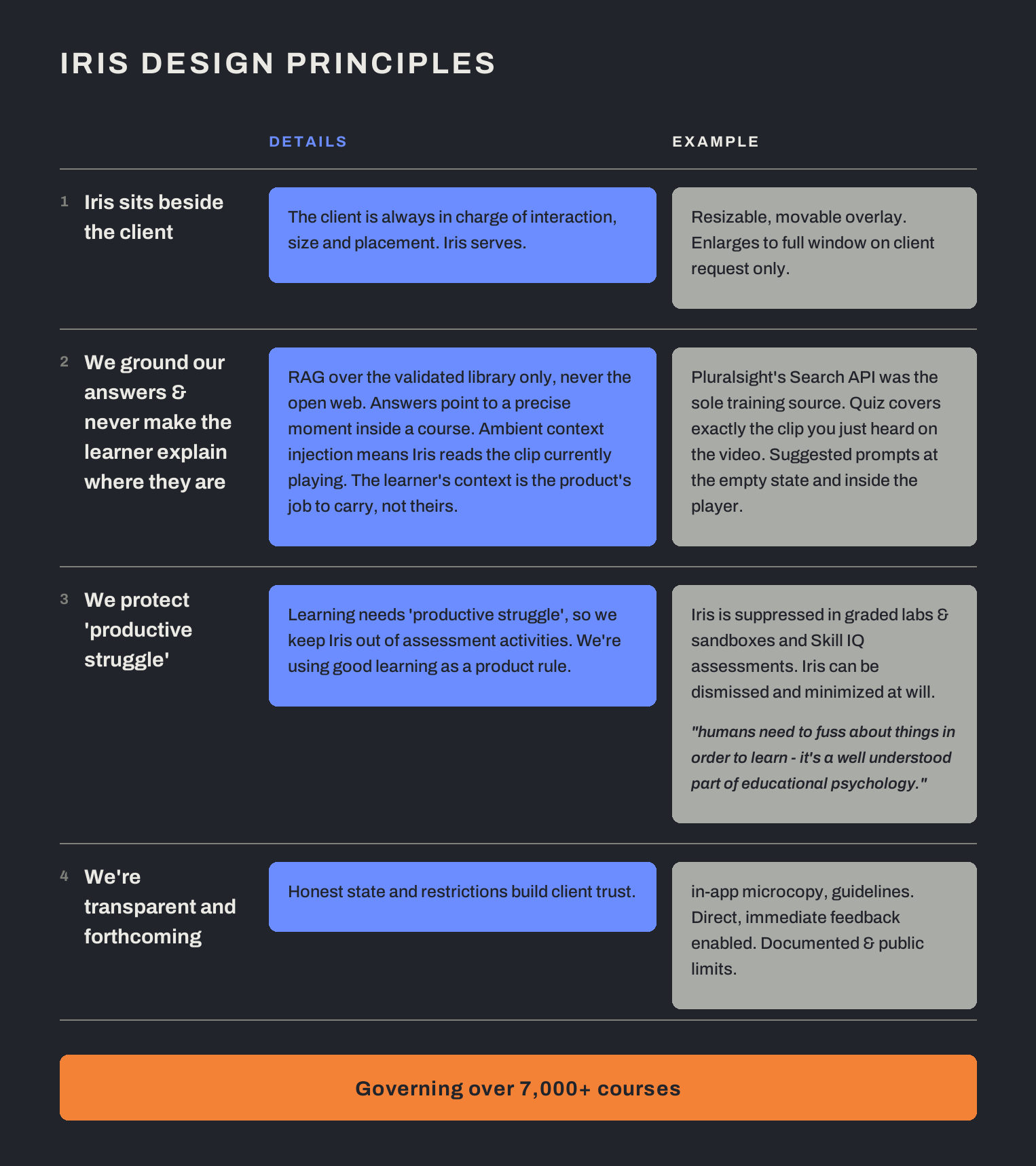
“Humans need to fuss* about things in order to learn – it’s a well understood part of educational psychology.
(… *yes, ‘fuss’ is the correct technical pedagogical term.)”
– from ‘Iris Design Principles’ wiki (by Skye)
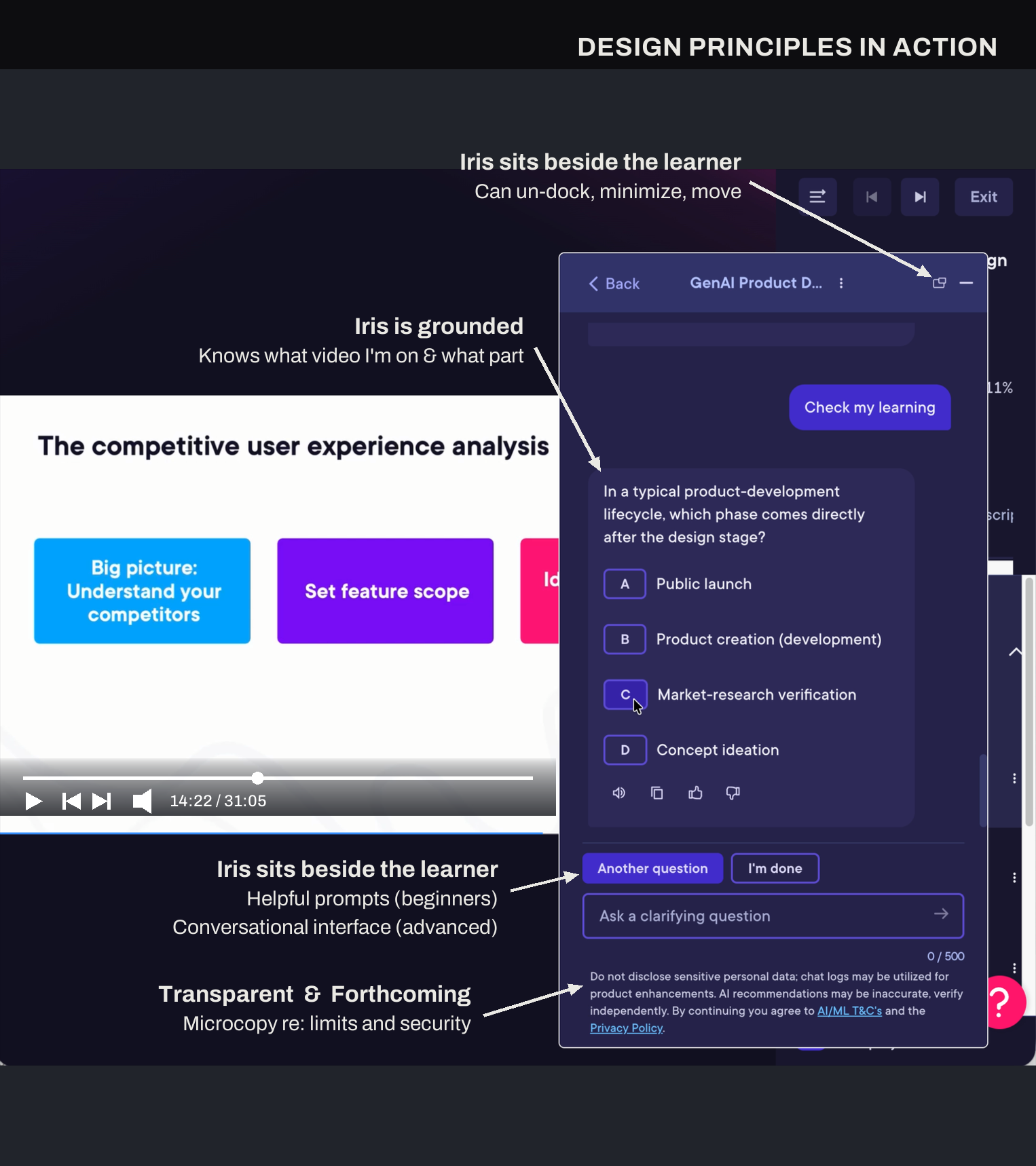
*Drag the center divider left or right to compare the design principles and their application on Iris
Tradeoffs: what changed, and who absorbed it.
- Data science & ML. Model and grounding choices came under a shared design standard.
- The analytics roadmap. AI dashboard-summary features were cut to refocus resources onto Iris build.
- Sales ops. The 16-step opt-in came off the customer roadmap
- My own team. A designer came off feature work to own AI as a surface, during a hiring freeze.
Just before launch, we found out there was a 16-step process for large enterprise companies to opt in to Iris. Lots of companies were starting the process (large demand for Iris) – few were finishing.
The company had just committed to focusing on enterprises with 500+ tech employees, and GenAI was strategic priority 04 of 5. We needed to expedite this process, and give enterprise clients the freedom to turn on or off Iris functionality themselves, without our involvement. I made it a retention argument: we’re restricting our flagship AI away from the exact segment the strategy depends on.
- Design & Product brought the evidence and possible new experience (proof of concept prototype)
- Business Strategy confirmed the economics and opportunity sizes
- Sales Ops owned the fix and shipped it.
Enablement moved from opt-in to on by default – engagement with Iris across the platform moved 13% immediately.
Results: Iris (grounded in Pluralsight's content) expanded from five product areas to the full catalog and increased engagement by 14% with sessions lasting ~2.5 minutes longer.
Outputs:
Iris, launched July 2024, grounded in the library and the learner's current activity
Five design principles and the patterns built from them, governing 5+ platform areas
Iris automatically on - opt out voluntarily, self-directed
Outcomes:
Stable standards: steady and scalable as Iris expanded from 5 areas to the whole catalog.
Learners went deeper. +2.5 min average sessions and +14% engagement after the Q3 2025 AI release.
Innovation. Grounded solely in validated content, not the open web, when most assistants were doing the opposite.
The Learning Experience Division’s work and impact was acknowledged
The team grew with the work.
- Approved to hire 3 designers (grew from 5 to 8 people).
- 4 of the 8 designers promoted over the next year.
Current Status (a/o Q4 2026)
- Iris is in production at www.pluralsight.com and still shipping as of 2026, with Guided Learning Prompts added.
- The principles still govern the surfaces Iris touches.
The ‘Iris shimmer’ in action, a way to help beginner learners understand the primary call to action (what we expect they will want to know right now in order to accelerate their learning)
I build senior capability by handing people the work one level above them (working with my assistance and guidance) on something the company is watching. The company’s most visible AI work was the best material I had for that, and I made sure I took advantage of this opportunity for the designers who wanted to be involved in AI work.
- With 6+ designers in active development at any time and 1-2 leaders, everyone gave critique and feedback at all phases of Iris design, so everyone was in the loop (and could sub in for any other designer – which happened during the project a few times)
- A designer owned Iris and AI as a surface, not as a feature queue. That meant carrying the principles into rooms I wasn’t in, and defending them there.
- A manager took the in-course knowledge checks end to end, partnering with data science on a surface where the model and the UX had to agree. (She was later promoted to Director).
- The team went from 5 designers to 8, and 4 of the 8 were promoted. In a turnaround with three org reductions behind us, I’m dang proud of that.
Lesson: I learned that a trustworthy feature still fails without usable onboarding, so I quickly evaluate the business model and customer journey before approving investment.
Lesson:
What did I get wrong here, and where did I apply what I learned?
Mistake: Focused too narrow (and missed the forest for the trees)
Focusing on quickly creating a feature in the face of market pressure, we didn’t account for onboarding and access.
- We created the vision, strategy, patterns etc and made them able to scale, per company aspirations of added growth via Gen AI capabilities (good job!)
- …but the onboarding was near impossible
- 16 steps to turn Iris on, opt-in only (really?!)
- Only 1/3 plans had it turned on
- Without the ability to easily reach all our clients, even a perfect feature would look sluggish and not valuable to customers.
The Fix: Consider the whole system (first)
What happens before and after the feature, the whole customer journey, also affects growth, adoption, retention.
How I applied this to the next project:
- Next project (‘Bring Your Own Content’ or BYOC), as part of discovery I looked at the business model and value stream
- The feature as scoped assumed that our company had capabilities – technical and resource-intensive hands-on assistance – that we did not have
- Before anything was built through engineers, design made a quick proof of concept (POC) prototype and used it to socialize the hypothetical added resources and functionality
How I knew it worked: Once the business was clear about the cost and long roadmap needed for this BYOC feature, we approved a Do Not Proceed status for this project before any money or additional resources or labor was wasted.
Skye’s Protip:
To anyone about to embark on AI transformation (any transformation, really), my top advice is consider whether you’re creating centaurs or creating reverse-centaurs.

“When techies describe their experience of AI, it sometimes sounds like they’re describing two completely different realities – and that’s because they are. For workers with power and control, automation turns them into centaurs, who get to use AI tools to improve their work-lives. For workers whose power is waning, AI is a tool for reverse-centaurism, an electronic whip that pushes them to work at superhuman speeds. And when they fail, these workers become “moral crumple zones,” absorbing the blame for the defective products their bosses pushed out in order to goose profits.
As ever, what a technology does pales in comparison to who it does it for and who it does it to.”
– from The Reverse Centaur’s Guide to Life After AI: How to Think About Artificial Intelligence Before It’s Too Late. Cory Doctorow, June 2026, Farrar Straus and Giroux (US) / Verso (UK).
Project Information
Leading the Company’s First Customer-Facing AI Product
Defining what trustworthy AI means for a learning platform, as principles and patterns. The Proof: adding value across all 7,000+ courses.
-
Design
Feb 2024 to Jul 2025. Public launch Jul 2024. (Still shipping as of 2026)
-
Client
Pluralsight. B2B SaaS, EdTech. ~ 1,900 employees.
PE-backed, in stabilization. -
My Role Then
Director of Product Design, Skills. Reported to the CPO.
-
Scope & Span
5+ platform areas. Course discovery, mid-course assessment, lesson summarization, translation
-
Team & Reach
8 direct reports. Partnered with Product, Engineering, Data Science, the business strategy team, and the internal ML Review Board.
-
Platform Type
B2B SaaS, multi-sided (Enterprise admin, individual learner, internal authoring)
-
Status (a/o Q4 '26)
In production at www.pluralsight.com
-
Tags
AI Product Design, Conversational/Gen AI, Enterprise Adoption, Governance, Operating Model, Transformation, Trust and Transparency